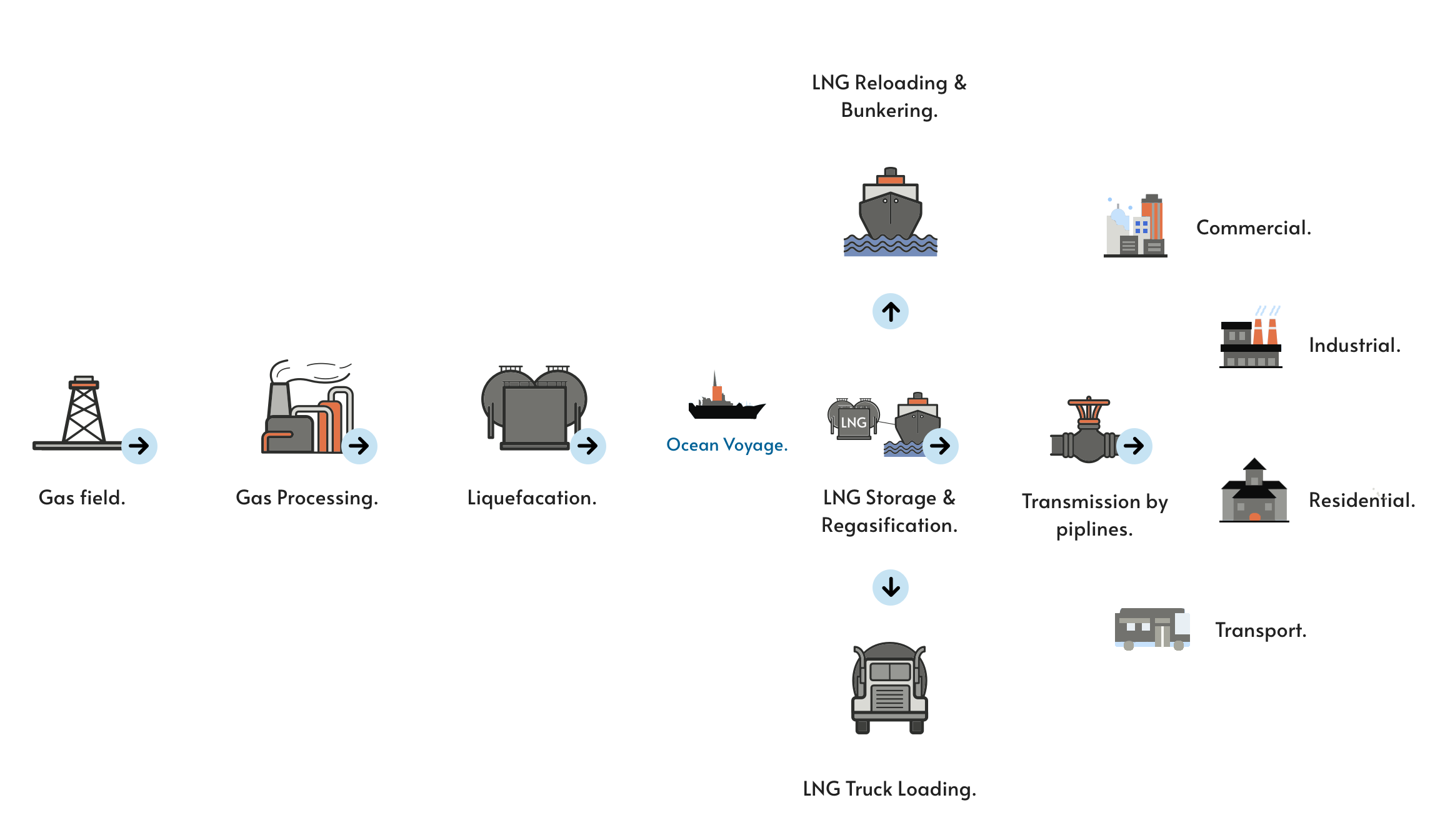
LNG Value Chain Comprises Five Key Steps
HEGMPL sources LNG from HEMD and re-gasifies it at H-Energy’s FSRU based LNG Terminal (WCPL) to supply R-LNG through pipeline network (Gas Transporter) or through trucks to end consumers.
-
 Production and treatment of Natural Gas
 -
Liquefaction of Natural Gas into LNG
-
Marine transport of LNG from liquefaction facility to destination
-
Receiving and storage of the LNG at the destination
-
Regasification and supply to end users
-
Natural Gas is produced from subsurface reservoirs located both onshore and offshore. The extracted gas is treated to remove impurities such as Nitrogen, Hydrogen Sulphide, Carbon Dioxide and Water. The treated gas is then transported to the liquefaction facility through Natural Gas pipelines.
-
LNG from the storage tanks at the liquefaction terminal is unloaded into double-hulled ships specifically designed to hold the cargo at or near atmospheric pressure and at a temperature of approximately -161°C. These ships travel over long-distance to transport LNG to its destination. Even with the insulation system in place, some amount of LNG evaporates (boil-off gas) and converts into Natural Gas. This is used by many vessels as supplement fuel during the voyage
-
LNG stored in the tanks is sent to vaporisers which heats and re-gasifies LNG into Natural Gas. This gas is transmitted through gas pipelines to meet the energy needs of a customers located in different regions of the country. Several customers across India are not connected to Natural Gas pipelines and laying new pipeline to reach them is commercially unfeasible. Such customers are supplied LNG directly to their door step through specialized cryogenic trucks.
-
To convert Natural Gas into LNG, it has to be cooled to a temperature of -161 C. This process takes place at a liquefaction terminal where Natural Gas is passed through several parallel units arranged in a sequential manner (LNG trains). In these units the heat from Natural Gas is transferred to cold stream of the refrigerants via LNG heat exchangers and Natural Gas is converted into LNG. LNG is then stored in cryogenic storage tanks at the terminal.
-
LNG ship then delivers this LNG at the receiving terminal located at the destination. LNG is stored in either on land storage tanks or in an FSRU. FSRUs are primarily LNG ships with onboard capability to vaporize LNG and deliver Natural Gas through specially designed offshore and near-shore receiving facilities, eliminating the need for on-land permanent structures. H-Energy’s Jaigarh terminal is an FSRU-based facility with a regasification capacity of 4 MMTPA.A new FSRU-based terminal can typically represent just 60% cost of an onshore terminal and can be delivered in a much shorter time. While an on-land terminal takes over 4-5 years to construct, FSRU-based terminal typically takes less than 2 years. FSRUs allow for greater flexibility in choosing a desired location for a regasification terminal, with fewer space constraints and limited onshore construction requirements. It also provides greater flexibility and can be relocated to different location to meet the seasonal demand.
A new FSRU-based terminal can typically represent just 60% cost of an onshore terminal and can be delivered in a much shorter time. While an on-land terminal takes over 4-5 years to construct, FSRU-based terminal typically takes less than 2 years. FSRUs allow for greater flexibility in choosing a desired location for a regasification terminal, with fewer space constraints and limited onshore construction requirements. It also provides greater flexibility and can be relocated to different location to meet the seasonal demand.