Use of Natural Gas

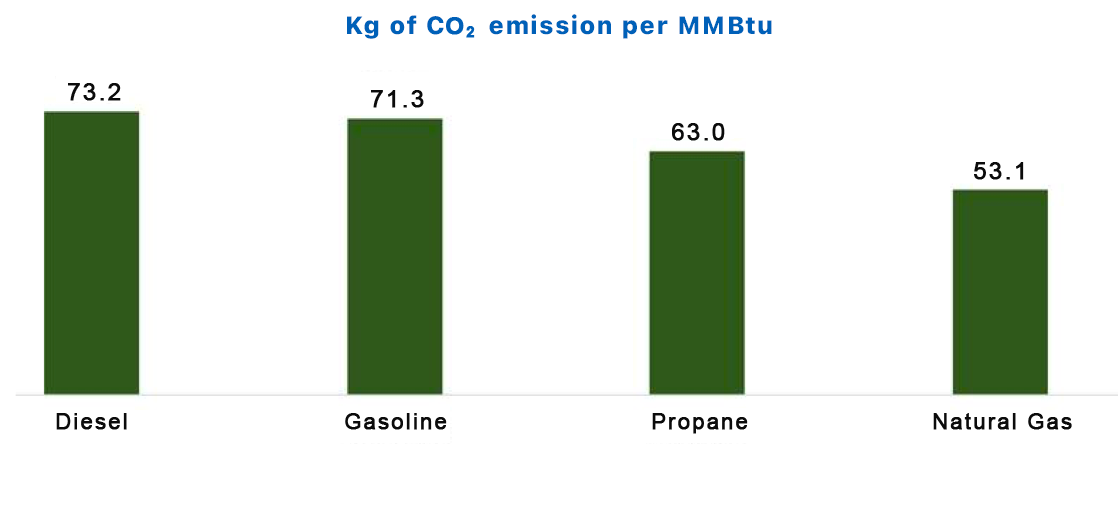
In addition to being cost-effective and flexible in its application, Natural Gas is also an environmental friendly attractive source of energy. When used for power generation, it emits one-third of the CO2 emissions of coal-fired power plants with the same electricity production. Further it also complements the development of renewable energy sources by acting as peaking power plants by addressing the challenge of seasonal and daily output variability of wind and solar energy.In comparison to coal-fired plants, new Natural Gas plants also emit significantly less Sulphur and, nitrogen oxides, and basically no particulate matter or heavy metals. Automobiles running on Natural Gas emit 20% to 30% less CO2 than those running on petrol. Natural Gas has already made significant strides as an automobile fuel for three- and four-wheelers in India. As on February 2020, there were about 3.6 million CNG vehicles and 2,086 CNG Stations in India. As more CGD networks are developed, the use of Natural Gas as a reliable, affordable and sustainable automobile fuel will increase.
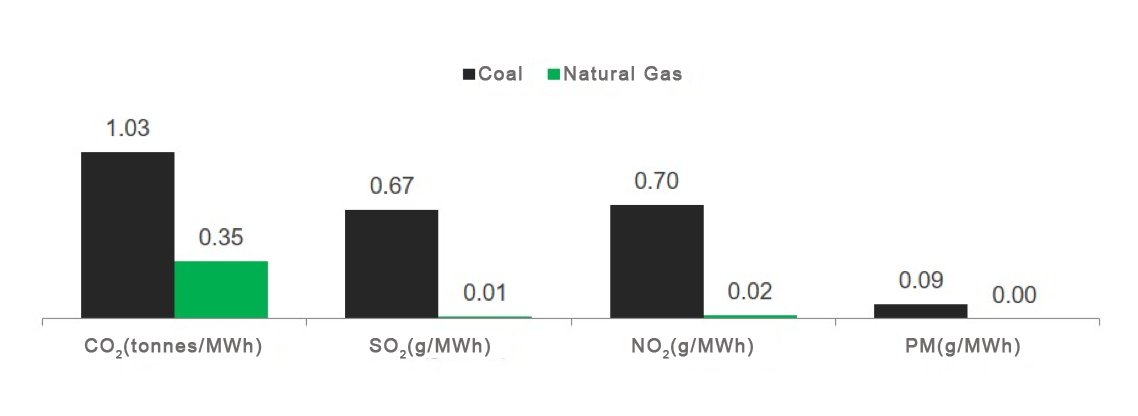
In comparison to coal-fired plants, new Natural Gas plants also emit significantly less Sulphur and, nitrogen oxides, and basically no particulate matter or heavy metals. Automobiles running on Natural Gas emit 20% to 30% less CO2 than those running on petrol. Natural Gas has already made significant strides as an automobile fuel for three- and four-wheelers in India. As on February 2020, there were about 3.6 million CNG vehicles and 2,086 CNG Stations in India. As more CGD networks are developed, the use of Natural Gas as a reliable, affordable and sustainable automobile fuel will increase.
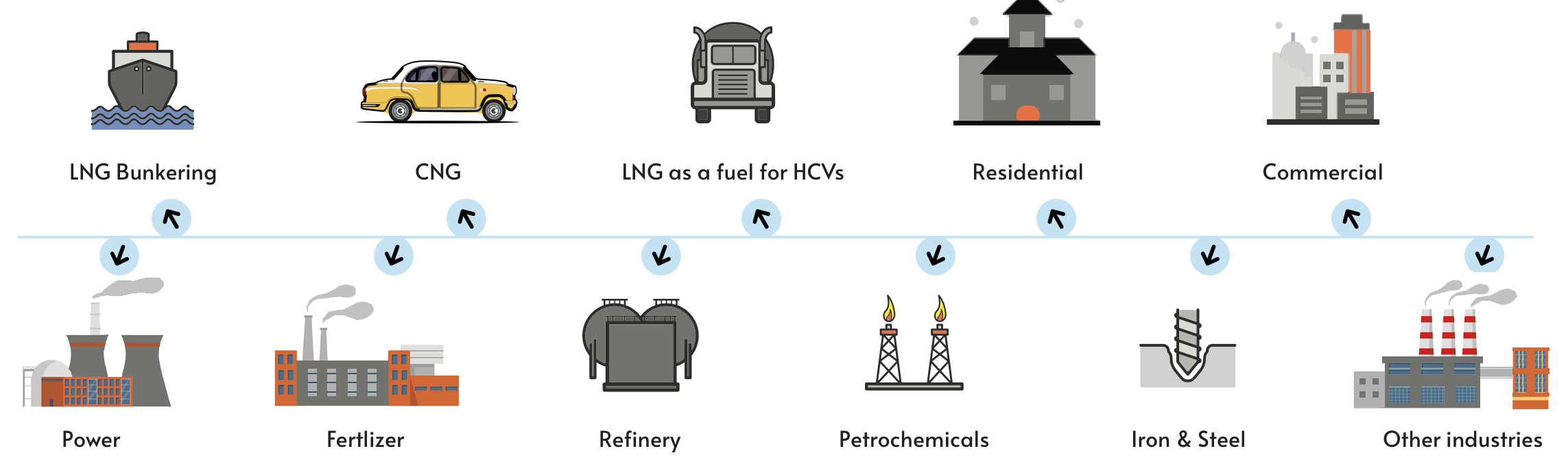
LNG is cheaper than diesel and has the potential to partly replace it as a fuel in heavy commercial vehicles (HCVs). LNG as an auto fuel in HCVs and public transport has economic as well as environmental advantages – it is 30-40% more efficient and emits less pollutants than all other auto fuels. Further due to lower taxes as compared to diesel it will be considerably cheaper.In addition to LNG use a fuel in HCVs, it can be also used to run railways engines and as a bunker fuel in shipping.
In addition to LNG use a fuel in HCVs, it can be also used to run railways engines and as a bunker fuel in shipping.
The Government of India has announced its plan to use LNG as a fuel for Indian Railways. At present, Indian Railways consume about 2.5 billion liters of diesel annually. The Government has projected that equivalent natural gas consumption will be about 1.8 million tons at 95% substitution. LNG is a perfect fuel for heavy duty engines involved in long haul transport across long distances. H-Energy is looking forward to supply LNG to Indian Railways and be the part of green revolution.
The maritime industry has seen increased interest in the usage of LNG to meet stringent environmental regulations. LNG Bunkering is a practice of providing LNG to a ship for its own consumption. H-Energy plans to supply LNG as bunker fuel from Jaigarh FSRU through barges to various Indian Ports.
LNG is very safe to transport. It is transported since 1959, and logs kept of maritime accidents shows that the industry’s safety record is exemplary.
LNG is very safe to transport. It is transported since 1959, and logs kept of maritime accidents shows that the industry’s safety record is exemplary.LNG is an odourless, non-toxic, transparent and non-corrosive liquid. If spilled on land or water, LNG vaporizes and leaves no residue behind. LNG has a high ignition temperature of 537oC and a narrow flammability limit. It will not ignite until it converts into vapour, and even then, the vapour will not ignite until it mixes with air and becomes extremely diluted (flammability limit of 5-15%).



 ©Copyright 2022 H-Energy | All Rights Reserved
